
Intent
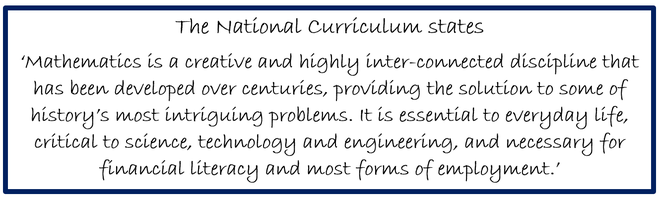
At Spring Gardens Primary School, we aim to equip all children with the skills and confidence to solve a range of problems through fluency with numbers and mathematical reasoning. We want our children to think mathematically and be able to transfer skills and knowledge in a range of different contexts. Teaching using the mastery approach, ensures a deep learning and understanding of key concepts taught across the curriculum. Our curriculum builds on what has been taught and is progressive, sequential and inclusive; it is sequenced so that new knowledge and skills build on what has been taught previously and the focus is towards clearly defined end points.
Implementation
At Spring Gardens, we use the National Curriculum, NCETM Professional Development materials and DFE Ready to Progress criteria to support planning and teaching mathematics. Ongoing formative assessment of what our children know, small steps in teaching and learning, and scaffolded support, ensure children have a secure and deeper understanding of the content taught.
Early Years Foundation Stage
Children in our Early Years Foundation Stage learn about mathematical concepts through active exploration and in their everyday play based learning. Children are taught key concepts and application of number using a hands-on practical approach. Teachers allow children time for the exploration and use of concrete objects and manipulatives, in order to help support children’s mathematical understanding. In Reception, daily direct teaching sessions enable the children to develop key skills in a progressive and sequential way. Maths in the early years provides children with a solid foundation that will enable them to develop skills as they progress through their schooling and ensures children are ready for the National Curriculum.
Key Stage 1
In our Early Years and Key Stage 1 classes, Mastering Number lessons are taught, in addition to the daily maths lesson. These lessons aim to secure firm foundations in the development of good number sense for all children from Reception through to Year 1 and Year 2. The aim over time is that children will leave Key Stage 1 with fluency in calculation and a confidence and flexibility with number. Attention is given to key knowledge and understanding needed in Reception classes, and progression through Key Stage 1 to support success in the future.
Key Stage 2
In Year 4 and Year 5, Mastering Number lessons are taught in addition to the daily maths lesson. These lesson support our children to develop automaticity in multiplication and division facts through regular practice, whilst also developing a sound understanding of number sense.
Early Years Foundation Stage
Nursery Maths Yearly Overview (NCETM)
Reception Maths Yearly Overview (NCETM)
Years 1, 2, 3 and 4 follow the NCETM mastery progression documents.
In the classroom
All classrooms have a designated maths area within them, where current topics are displayed, as well as the mathematical vocabulary the children will be expected to use. Children are encouraged to use precise mathematical vocabulary throughout lessons and to confidently explain the meanings of these words.
Lessons focus on one key idea and connections are made across mathematical topics to ensure children are fluent within that concept. The expectation is that every child will master a concept and then move on to greater depth reasoning and problem solving.
Manipulatives and visual representations are used within lessons to transform abstract concepts into tangible, observable experiences. We use a Concrete-Pictorial-Abstract approach which allows the children to move from a ‘hands on’ experience, to visual scaffolds, and finally abstract symbols. This approach helps to bridge the gap between physical reality and abstract reasoning, which in turn, supports the retention of long-term knowledge and problem-solving skills.
An ‘I do…we do…you do’ approach supports and scaffolds learning across all year groups and allows all learners to experience success in maths.
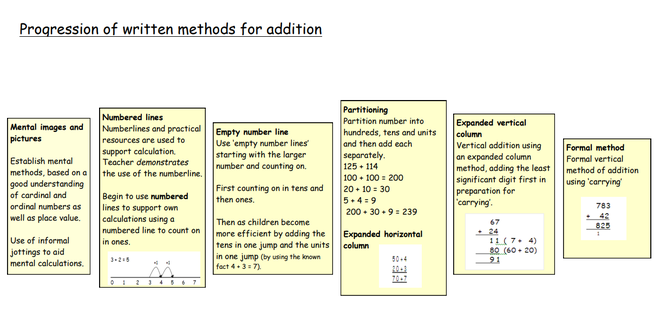
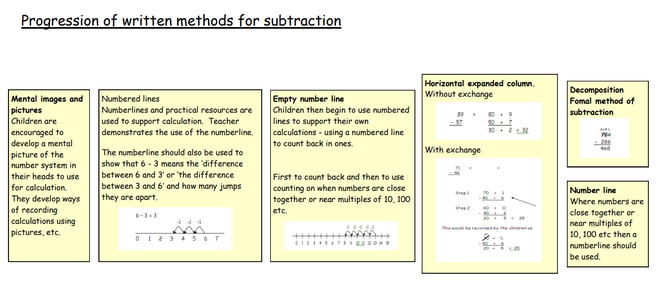
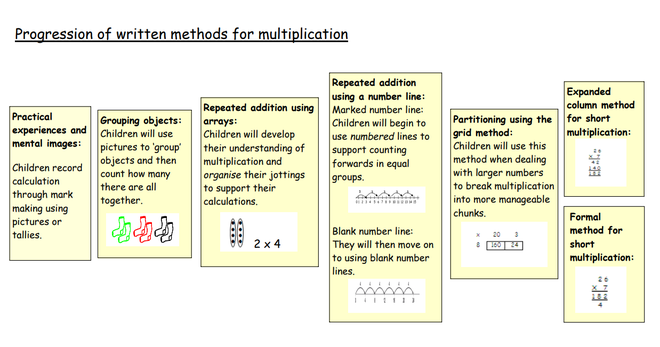
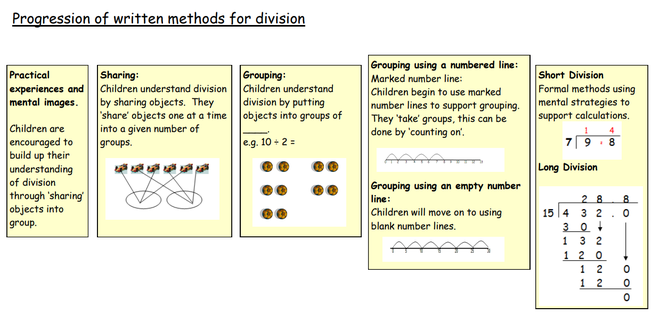
Spring Gardens Primary School Calculation Policy
Impact
Throughout each lesson, teacher’s use formative assessment to adapt and tailor planning to ensure a mathematics curriculum is taught which allows every child to succeed. Marking, as well as verbal feedback, allow teachers to identify any misconceptions where children can address errors.
Pre assessments are used to measure learning of previously taught concepts before the teaching begins. These assessments are used to inform and adapt planning where needed. After a new unit has been taught, a post assessment is completed by the children. Through the use of a ‘Memory Jogger’ at the beginning of each lesson, previously taught concepts are returned to, which allow children to consolidate their understanding and remember more.
Each term, children in Key Stage 2 complete a summative assessment to allow them to demonstrate their knowledge and understanding of topics covered. Results from both formative and summative assessment are then used to determine children’s progress and attainment.
Times Tables Support
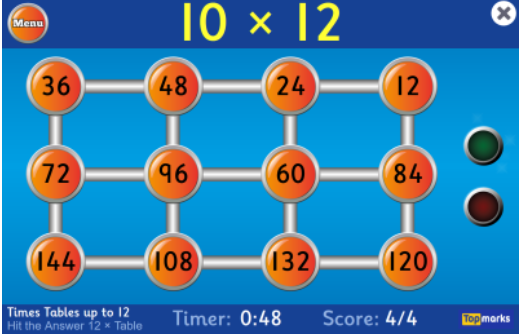
Hit the Button

Times Tables Rockstars

CannonBall
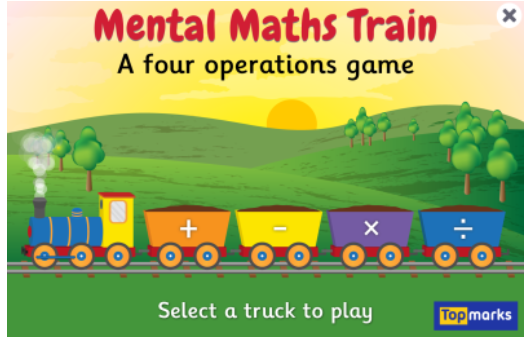
Maths Train
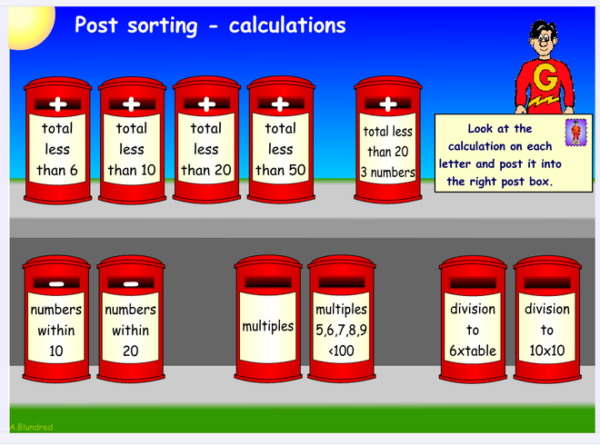
Post Box Sorting

Multiplication.co.uk (various games)
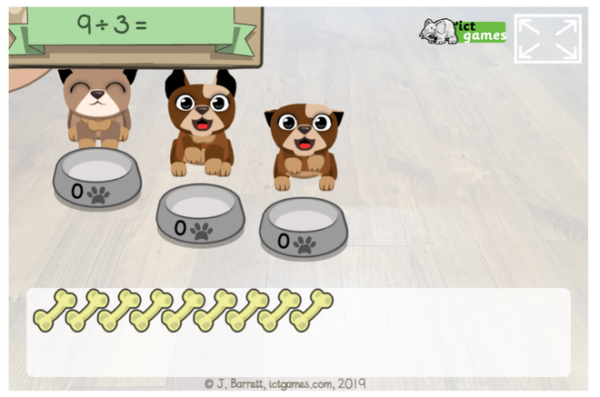
Doggy Division Dinners
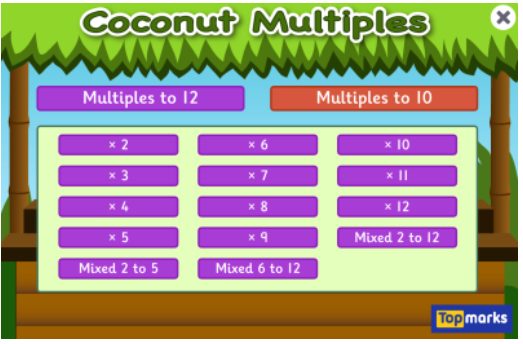
Coconut Multiples
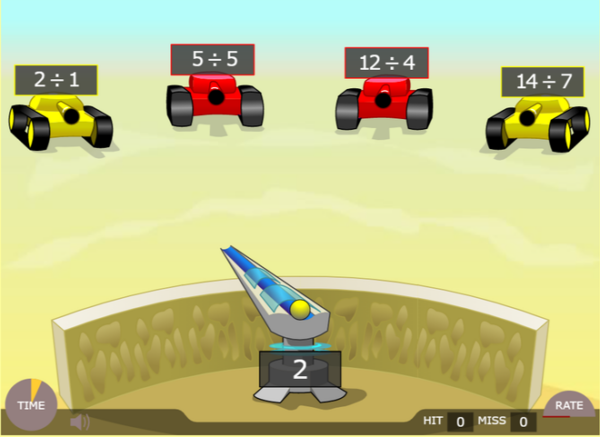
Demolition Division